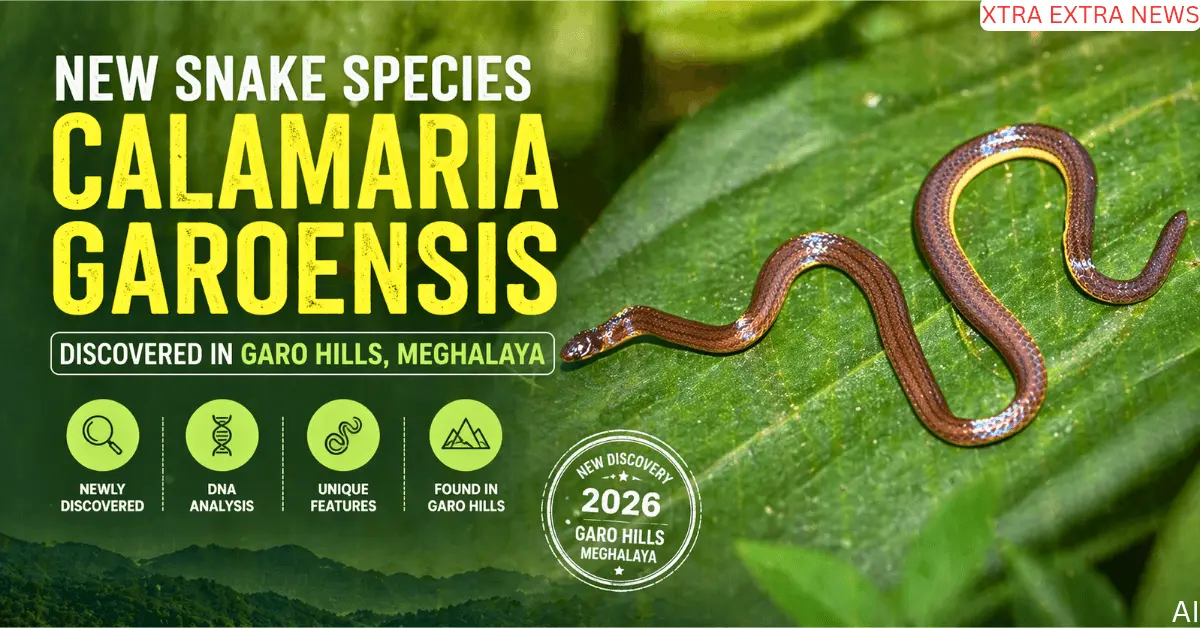

In April 2026, scientists shared exciting news. They had found a completely new snake species. This snake was named Calamaria garoensis. It was discovered in the forest areas of Garo Hills in Meghalaya, India.
Think about this for a moment. We live in 2026. We have smartphones, satellites, and advanced technology. And still, scientists are finding animals that nobody knew about before. That is truly amazing.
This discovery tells us something important. Earth still has many secrets. Many animals are still unknown to science. We have not yet discovered everything that lives on our planet.
Because of this discovery, the Garo Hills have become a very important place for research. This region has rich biodiversity. That means it has a large variety of plants and animals living together. Scientists now believe that even more new snake species and other animals may be found in this region in the future.
Who Made This Discovery?
This was not the work of just one scientist. It was a team effort. Many researchers worked together for a long time to confirm this discovery.
Several Indian institutions took part in this research. These include Help Earth, Cotton University, Assam Don Bosco University, Mizoram University, and the Zoological Survey of India. An international organization called the National Research and Innovation Agency also supported the study.
After completing their work, the scientists published their findings in a scientific journal called Taprobanica. This journal shares studies about animal classification and biodiversity.
How Did Scientists Identify The New Snake Species?
Here is where it gets really interesting. Finding a new snake species is not simple. Scientists follow a very careful, step-by-step process.
Step 1 – Field Surveys
First, scientists went into the forests of the Garo Hills. This work is called a field survey. They searched the forest areas carefully, looking for snakes and collecting samples. This kind of work takes many years of patience and effort.
Step 2 – The Confusion Begins
At first, this snake confused the scientists. Why? Because it looked very similar to other snakes that were already known. Just by looking at it, scientists could not say it was a new species. It was easy to mix it up with another snake.
Step 3 – DNA Testing
To solve this confusion, scientists took samples to a laboratory. There, they studied the snake’s DNA. They used a method called mitochondrial DNA analysis. This method helps scientists find genetic differences between animals.
The results were clear. This snake was genetically different from a related species called Calamaria mizoramensis. About a 6.3 percent genetic difference was observed in the study. This may sound like a small number. But in science, this difference is significant. It means the snake has a completely different evolutionary history.
Step 4 – Studying the Physical Features
Scientists also studied the body of the snake very carefully. This is called morphological analysis. They looked at the shape of the body, the arrangement of the scales, the tail, and other visible features.
Both the DNA results and the physical examination confirmed the same thing. This was definitely a new snake species. It was then officially named Calamaria garoensis, after the Garo Hills where it was found.
Also Read: Hidden Meaning Behind The Name “Pink Moon”
What Does Calamaria Garoensis Look Like?
So what does this new snake species actually look like? Let us find out.
The snake Calamaria garoensis is small and has a thin body. It lives underground. This underground lifestyle is called fossorial. The snake spends most of its time beneath the soil.
Here are some key physical features:
- Its back has smooth scales which are arranged in thirteen rows.
- Its tail is short and blunt, unlike most snakes that have longer or pointed tails.
- It has a wide black stripe under its tail, which is a very useful feature for identification.
- Its body has faint lines running along its length, which help it stay hidden in soil and leaf litter.
These features help the snake stay safe from predators and survive in its natural environment.
Why Is Garo Hills So Special For New Snake Species Research?
Garo Hills is already known for its rich biodiversity. Many plants and animals live here. But the interesting part is that many species in this region have never been properly studied.
The discovery of Calamaria garoensis shows exactly why detailed research matters. This snake looked similar to a known species. Without DNA analysis and careful physical study, scientists would have missed it completely.
Large parts of the Garo Hills still remain unexplored. Scientists believe that many more new snake species and other animals are still waiting to be discovered there.
Why Should We Protect This Snake?
Till now, Calamaria garoensis exists only in the Garo Hills region. Because it lives in such a small area, it could easily be at risk if its habitat is damaged or destroyed.
The Chief Minister of Meghalaya, Conrad K. Sangma, commented on this discovery. He said that such findings increase the value of the state’s natural heritage.
This is a very important point. All species have some part in the ecosystem. If one species disappears, it affects other plants and animals too. Keeping the Garo Hills forests safe is necessary to protect this new snake species in the future.
Continued research and conservation work will help protect the biodiversity of Garo Hills and ensure that unique species like Calamaria garoensis continue to exist for generations to come.

 By
By