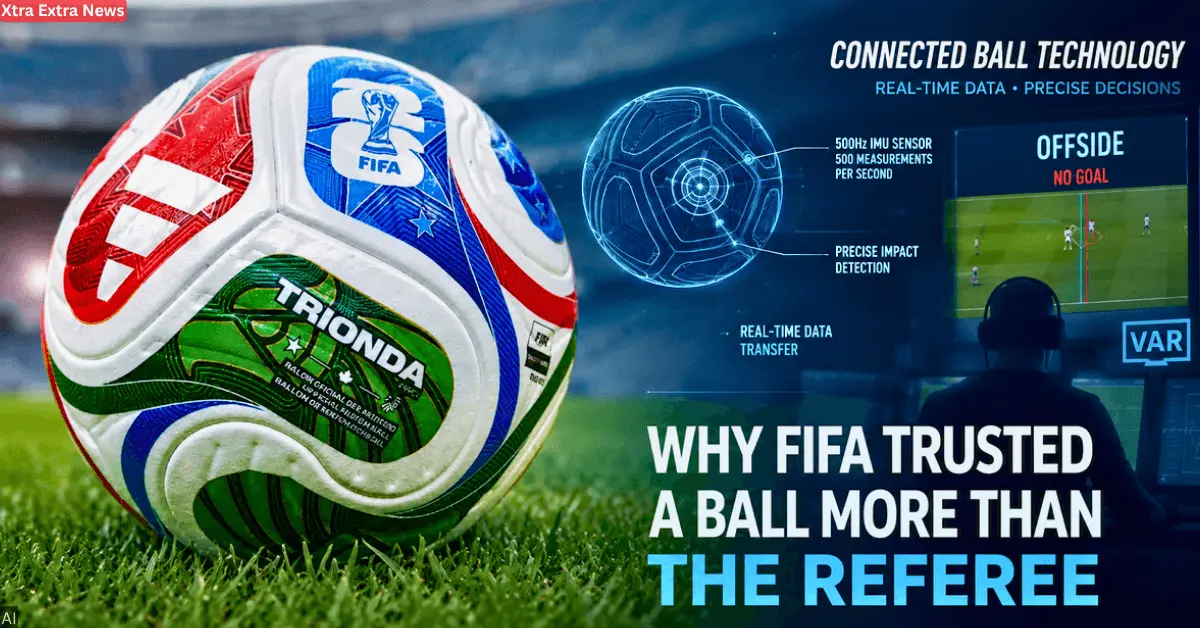

Can a football help officials make better decisions than their own eyes? Yes, and the FIFA World Cup 2026 proved it.
At the FIFA World Cup 2026, a special technology is used inside the match ball. Many people call it the FIFA ball micro chip. This was not made to remove referees from the game. It was made to help them get the right answer faster. The system is referred to as the Connected Ball Technology. It gives officials extra information about things that happen on the field – things that move too fast for any human to see clearly.
How The Ball Knows The Exact Moment A Pass Happens
In football, timing matters a lot. Even a small difference, less than one second, can decide if a player is onside or offside.
Before this technology, referees and VAR officials used video to find the exact moment a player kicked the ball. Cameras are good, but they still take a limited number of pictures every second. So the exact moment a foot touches the ball can sometimes fall between two frames. Nobody sees it clearly.
FIFA fixed this problem with the FIFA 2026 ball sensor. Inside the ball is a sensor called a 500Hz IMU. This sensor records the ball’s movement 500 times every single second. That is very, very fast.
This means the system can find the exact moment a player’s foot makes contact with the ball. That information goes straight to FIFA’s Semi-Automated Offside Technology. Now, instead of guessing from the video, officials get exact data. Offside decisions become faster and much more accurate.
How The Ball Detects Touches That People Often Miss
Not every touch is easy to see.
Sometimes the ball lightly touches a player’s hand. Sometimes it brushes a boot or takes a small deflection before changing direction. All of this occurs in just a split second. Even after watching many replays, officials can still be unsure about what actually happened.
This is where the FIFA ball micro chip becomes very useful.
The sensor inside the ball always measures speed, direction, and acceleration in three directions. Every time something touches the ball, even very lightly, the ball’s movement changes. That change shows up immediately in the sensor data.
So even if a touch is too small to see on camera, the ball still records it. Even something as small as a deflection, a possible handball, or a tiny contact can produce an entry into their database.
This helps officials review incidents faster. They can look at camera footage and sensor data together. This gives them more confidence when making decisions about handballs, deflections, and disputed touches.
Also Read: Why iPhone 18 Buyers May Skip The Base Model
How Ball Data And Stadium Cameras Work Together
Football is a fast game. Players move, pass, turn, and change direction in just a few seconds. No referee can watch everything at the same time.
To help with this, FIFA connects data from the ball sensor with information from special tracking cameras placed around the stadium. These cameras watch every player’s position and movement throughout the whole match.
At the same time, the ball is sending its own movement data in real time. The system takes both sets of information and combines them.
Now officials can see where every player is, when the ball was played, and how those two things connect. Everything is processed automatically, so situations that used to take several minutes to review can now be checked in just seconds. The result is sent directly to the VAR team.
Why Technology Can Notice Things Human Eyes Cannot
Even the best referees in the world have limits.
Another player can block their view. A fast action can occur beyond their line of vision. Human reaction time also affects what they notice during a match.
Technology does not have these problems.
The FIFA 2026 ball sensor works throughout the entire match. It does not get tired. It does not lose focus. It does not depend on any one camera angle. Every movement of the ball is recorded and sent instantly.
This means potential offside, small touches, and disputed moments can all be spotted faster than any human could manage on their own.
But FIFA is clear that technology does not make the final call. The referee always decides. The technology just gives officials stronger, more accurate evidence.
The engineering inside the ball is also very impressive. The FIFA ball micro chip includes a sensor, a small rechargeable battery, and a unit that sends data during play.
Adidas designed the ball carefully so that the electronics inside do not affect how the ball moves or feels. The battery is charged wirelessly before every match, making sure the Connected Ball Technology is fully ready from the first minute to the last.

 By
By