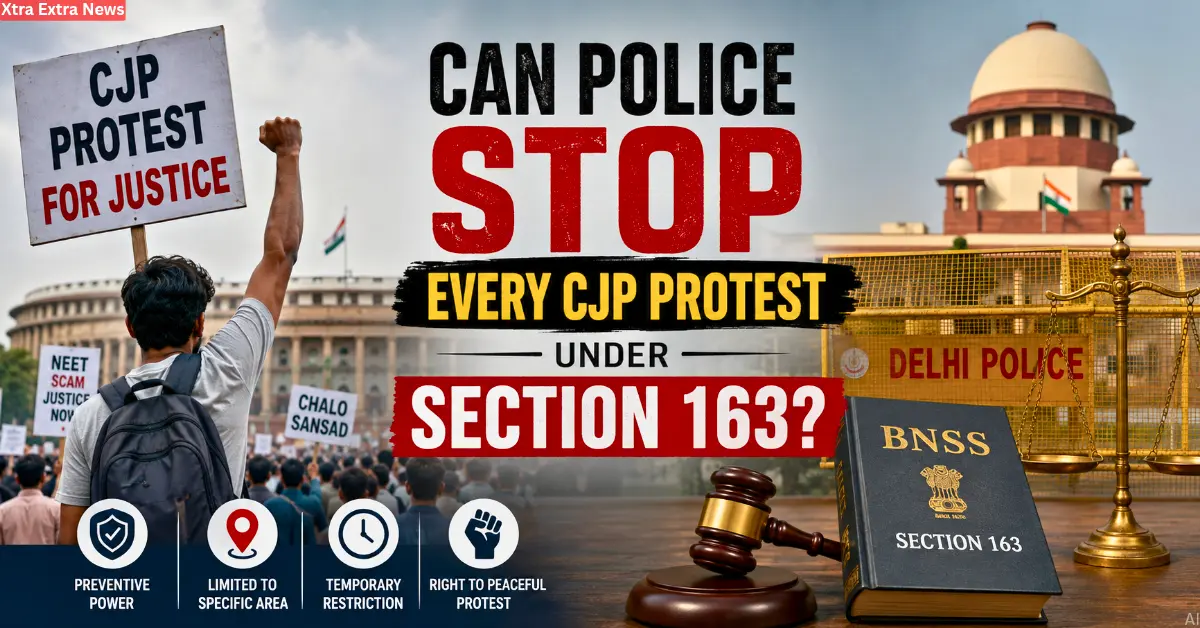

Before the Monsoon Session of Parliament, the Delhi Police used Section 163 BNSS before the Cockroach Janta Party’s (CJP) planned “Chalo Sansad” march on 20 July 2026 over alleged NEET irregularities. This quickly started a big public discussion. Can police stop every CJP protest with Section 163? Many wonder. The answer cannot be given as only yes or only no. Section 163 BNSS gives authorities preventive powers, but those powers also have legal limits. Let us understand what the law really says.
What Really Happened On July 20?
Imagine planning a big march, only to find out the police have blocked the area. That is exactly what happened to the CJP. Before their march, the Delhi Police enforced Section 163 BNSS in the New Delhi district. Why did they do this? The march was moving toward the Parliament area. Since Parliament is one of the most secure places in the country, the police wanted to avoid big law and order problems during the busy Parliament session.
Under this order, public gatherings, marches, and rallies were temporarily stopped in that specific area. It meant five or more people could not gather together there for a limited time.
When people heard this news, many started asking: Is every single protest in Delhi now banned? The quick answer is no!
- The restrictions applied only to the small area mentioned in the written order.
- The rules did not apply to the whole city of Delhi or the rest of India.
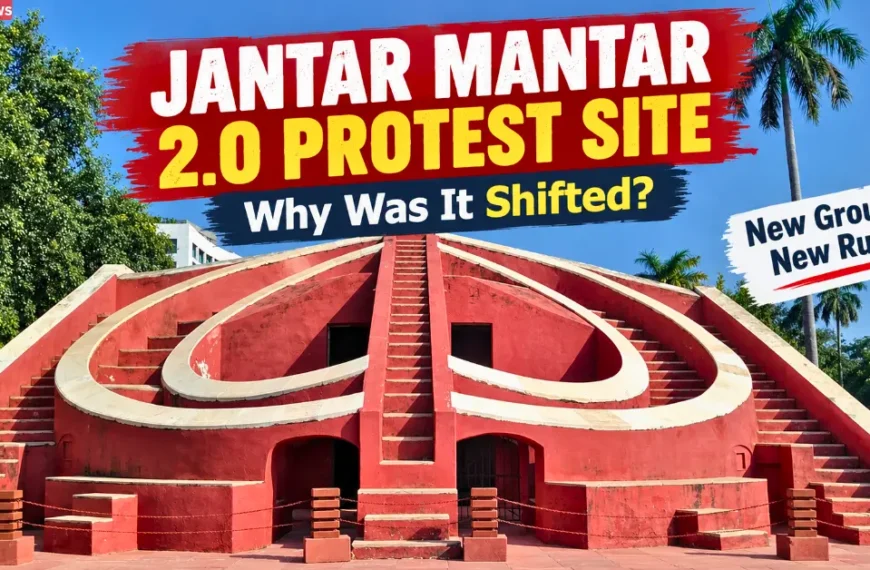
- The famous protest site at Jantar Mantar was still open for demonstrations.
However, the organizers still needed to get official permission before holding a protest at Jantar Mantar. Therefore, the core issue was not a full prohibition of protests. It was simply about protecting the high-security zone near Parliament.
What Does Section 163 Actually Allow?
You might hear about Section 163 on the news all the time, but what does this law actually do? Let us break it down simply. On 1 July 2024, India got new criminal laws. Instead of the old Section 144 CrPC, we now have Section 163 BNSS in use.
Under Section 163 BNSS, a District Magistrate or an authorized Executive Magistrate can pass a written order to stop gatherings. But they can only do this if they believe there is an immediate risk to public peace, human life, health, or safety. The main goal of this section is to stop a serious problem before it even begins.
Does this mean officers can use Section 163 BNSS whenever they feel like it? Absolutely not! These points have very clear answers in the law:
- It is only for temporary situations where there is a real, urgent danger.
- It is not a permanent rule to ban all public meetings forever.
- The order must be in writing and explain the exact reason for the restriction.
- It must clearly state which exact streets or areas are covered and how long the rules will last.
These strict rules make sure that authorities do not misuse the law without a genuine reason.
Also Read: Why Isha Ambani Rejected A Gown For The Met
Can Police Stop Every CJP Protest?
The main question now is: Can Section 163 let police arrest all CJP protesters? To that, the direct and plain answer is no.
The police cannot just ban every protest automatically. An order under Section 163 only works in the specific place and for the exact time written in the official paper. It does not apply a total ban to Delhi or all of India.
Before using Section 163 BNSS, the Magistrate must write down clear, solid reasons. They must prove there is a real, factual threat to public safety or peace. The law does not allow them to guess or act out of general fear.
Important Fact: India’s Constitution gives every citizen a beautiful right – the right to hold peaceful protests.
Of course, the government can put reasonable restrictions to keep people safe, but courts have said these restrictions must be fair, necessary, and balanced. They cannot be used to take away people’s rights without a very good reason. Therefore, Section 163 cannot legally be used to cancel every CJP protest.
Why Was This Protest Restricted?
So, what went wrong with this specific CJP march? The Delhi Police pointed out two main things. First, the organizers did not get prior official permission for the “Chalo Sansad” march. Second, the path of the march was too close to Parliament, which requires very high security.
Although safety was a concern, the protest stayed free from a complete ban. The CJP could still hold their demonstration at Jantar Mantar if they simply asked for the required permission first. This proves the restriction was only about the location and safety, not about stopping the CJP from speaking out.
Lastly, keep in mind that if someone knowingly breaks a valid order under Section 163 or Section 163 BNSS, they can face legal trouble under Section 223 of the Bharatiya Nyaya Sanhita (BNS) for disobeying a public servant.
In the end, Section 163 BNSS is just a temporary safety tool for specific emergencies. It does not give the police unlimited power to stop every CJP protest everywhere or at all times.
Also Read: Spain vs Argentina – Biggest Surprise Before Final

 By
By