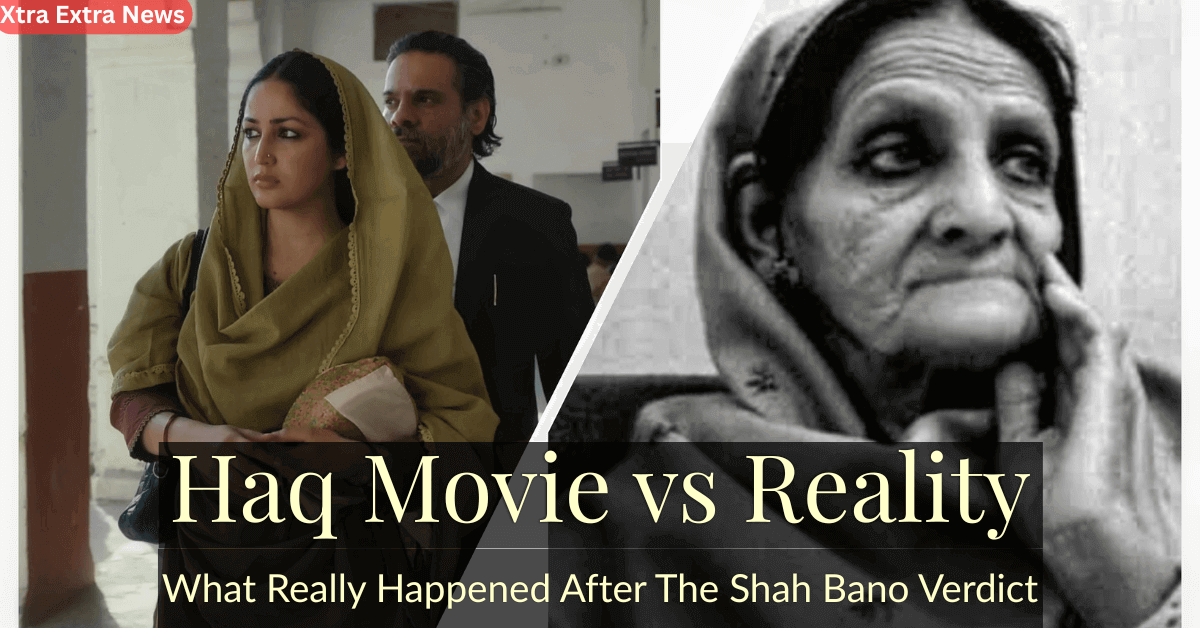

The 2025 film Haq shows a strong courtroom fight. In the movie, the ending feels clear and hopeful. The woman wins her case. Justice looks done. The viewer feels relaxed, as if the story is complete and everything is settled.
But real life was very different.
The real story behind the Haq movie 2025 is based on the famous Shah Bano case. After the 1985 court judgment, life outside the courtroom became very painful, emotional, and political. The decision of the judges did not close the matter. Instead, it opened a long and serious national debate that went on for many years.
This article looks closely at the Shah Bano case history and explains what really happened after the verdict. It talks about the protests, the change in law, Shah Bano life after court case, and how later courts tried to correct what politics had changed. If the movie Haq made you curious, the real story is even deeper and more powerful.
What The Court Decided In 1985
In 1985, the Supreme Court of India gave a historic decision in favor of Shah Bano. She was a 62-year-old Muslim woman. Her husband had divorced her and left her without enough money to survive. She had no proper support. So, she went to court and asked for maintenance from her husband so that she could live with dignity.
The court carefully studied the law. It said that Section 125 of the Criminal Procedure Code applies to all citizens. It does not change because of religion. The judges clearly said that a woman’s right to basic financial support cannot be taken away in the name of personal law.
This meant that a divorced Muslim woman could also ask for maintenance if she could not support herself. The legal battle of Shah Bano became a strong symbol of women’s rights in India.
Many people across the country praised the judgment. They felt it supported fairness, humanity, and survival. The court made it clear that no woman should be left helpless after divorce, no matter what her religion is.
At that time, many believed this decision would change women’s lives for the better. It looked like a big step forward.
Why The Decision Caused Anger And Protests
Soon, the Shah Bano case history moved out of the courtroom and into daily life.
Debates started everywhere. Newspapers, magazines, public meetings, and political groups all began talking about the verdict. Many conservative Muslim organizations became very angry.
They believed the court had interfered with Islamic personal law. For them, the issue was not only about money or maintenance. It was about religion, culture, and identity. They felt their religious rights were under threat.
Large protests were organized in many cities. Leaders gave speeches. People came out on the streets. Political pressure on the government increased very fast.
The Shah Bano case became a national issue. It was no longer only about one woman. It became a sensitive debate about religion, law, women’s rights, and the power of the government.
The atmosphere grew tense. What had started as a simple maintenance case had now become one of the most emotional and serious public discussions in the country.
How The Government Changed The Law In 1986
In 1986, the government led by Prime Minister Rajiv Gandhi decided to respond to the growing pressure.
A new law was passed in Parliament. It was called the Muslim Women (Protection of Rights on Divorce) Act, 1986.
This law changed the effect of the 1985 judgment. It said that a husband’s main duty to support his divorced wife was limited to the iddat period. This period is about three months after the divorce.
After this time, the husband was mostly free from responsibility. The law said that relatives or the Waqf Board could support the woman if needed.
Because of this, the strong meaning of the Supreme Court’s decision was reduced. Even though the law was presented as protecting women, in reality, it narrowed their right to long-term maintenance.
In simple words, politics changed what the court had decided. The clear legal victory shown in Haq was weakened in real life.
Many people across the country felt disappointed. They believed the government had stepped back instead of moving forward.
What Happened To Shah Bano After This
Behind the famous legal battle of Shah Bano was a real woman with real emotions.
After the new law, Shah Bano faced strong social pressure. Many people from her own community opposed her. She was criticized, questioned, and constantly talked about in public.
Reporters followed her. Political groups spoke about her. Her private life became national news.
Because of this pressure and because of the new law, Shah Bano later withdrew her claim for maintenance.
Shah Bano life after court case was not calm or happy. Her struggle had changed the laws of the country, but it had also changed her personal life forever.
She had stood alone in the middle of a national storm. The emotional pain was heavy. Her name became a symbol, but behind that symbol was a woman who had suffered deeply.
Her story reminds us that big court cases are not only about laws. They are also about real people who carry the burden.
How Later Courts Brought Back The Main Idea
The story did not end with the 1986 law.
In 2001, the Supreme Court again looked at this issue in the Danial Latifi case. The judges studied the 1986 Act very carefully.
They gave an important explanation. They said that the husband must make a “fair and reasonable provision” for the future of his divorced wife. This full support must be arranged within the iddat period.
This meant that even if the money was given within three months, it had to cover the woman’s long-term needs, not just for a short time.
This decision quietly brought back the main idea of the 1985 judgment.
The courts restored what politics had limited. The true spirit of the Shah Bano case history returned.
It showed that even when laws are changed, courts can still protect the basic rights of women.
Real-Life Family Story And The Haq Movie In 2025
Shah Bano passed away in 1992 after suffering a brain hemorrhage. Her former husband, Mohd. Ahmed Khan died in 2006 at the age of 94.
Many years later, their story again came into public view.
In 2025, the film Haq was announced and released. It showed a dramatic version of the legal battle of Shah Bano and its courtroom outcome.
Before the film was released, Shah Bano’s daughter, Siddiqua Begum Khan, filed a case. She said the movie had factual mistakes and was made without the family’s permission.
She asked the court to stop the release.
The Madhya Pradesh High Court dismissed her plea.
After that, Haq was finally released in November 2025.
However, many people may still not know the real story behind Haq movie 2025.
For many viewers, the movie was emotional. But the real story, with all its pain, politics, and long struggle, is even more powerful. It reminds us that justice is not always simple, and that behind every famous case is a human life that was deeply affected.
Keep this site bookmarked for the latest updates and news.

 By
By